Compound Interest Calculator
See how your investment grows with the power of compounding
Growth Summary
Principal vs Interest
Year-by-Year Growth
| Year | Contributed | Interest | Balance |
|---|---|---|---|
| 1 | $10,000.00 | $722.90 | $10,722.90 |
| 2 | $10,000.00 | $1,498.06 | $11,498.06 |
| 3 | $10,000.00 | $2,329.26 | $12,329.26 |
| 4 | $10,000.00 | $3,220.54 | $13,220.54 |
| 5 | $10,000.00 | $4,176.25 | $14,176.25 |
| 6 | $10,000.00 | $5,201.06 | $15,201.06 |
| 7 | $10,000.00 | $6,299.94 | $16,299.94 |
| 8 | $10,000.00 | $7,478.26 | $17,478.26 |
| 9 | $10,000.00 | $8,741.77 | $18,741.77 |
| 10 | $10,000.00 | $10,096.61 | $20,096.61 |
What Is a Compound Interest Calculator?
Money grows faster once interest starts earning interest on itself. That's the whole idea behind compounding, and it's why $10,000 invested at 30 ends up somewhere completely different than $10,000 invested at 45, the extra years give the snowball more time to roll.
This calculator gives you a real projection instead of a rough guess. Enter your numbers and you'll see a year-by-year breakdown, not just a final total, so you can spot exactly when growth starts accelerating.
How Compound Interest Works
Interest gets calculated on your principal plus whatever interest has already built up. Compound more often, and the growth happens a bit faster, though the difference between, say, daily and monthly compounding is smaller than most people expect.
- Formula:
A = P(1 + r/n)^(nt)
- A = final amount (principal + interest)
- P = principal (initial deposit)
- r = annual interest rate (as a decimal, e.g., 0.07 for 7%)
- n = number of times interest compounds per year
- t = time in years
If you're adding regular monthly contributions, the calculator adjusts the formula to add each new deposit before compounding continues, this is why even small, consistent contributions can outgrow a larger one-time deposit over long periods.
How to Use CalciHub's Compound Interest Calculator
- Enter the starting principal, the amount you're investing or saving today.
- Enter the annual interest rate and check your account's stated APY or your investment's expected return.
- Choose the compounding frequency: daily, monthly, quarterly, semi-annually, or annually.
- Set the time period in years for how long the money will stay invested or saved.
- Optionally add a monthly contribution; see how regular deposits change the outcome.
- Click Calculate to get your final balance, total interest earned, and a year-by-year breakdown
Tip: Daily compounding does beat annual compounding, but the gap is usually only a small percentage over long periods. Rate and time period matter far more than compounding frequency, don't let a "daily vs. monthly" decision distract from finding a better rate or investing for longer.
A Quick Example
David puts $5,000 into a high-yield savings account earning 5% annual interest, compounded monthly. He leaves it untouched for 10 years.
- Principal: $5,000
- Annual rate: 5%
- Compounding: Monthly
- Time: 10 years
- Final balance: $8,235.05
- Total interest earned: $3,235.05
David's money grew by about 65% without him doing anything beyond leaving it alone. If he'd started 10 years earlier and left it for 20 years total, that same $5,000 would grow to $13,535, nearly triple the original deposit. That extra decade, not a higher rate, is what made the biggest difference.
Try your own numbers above to see what your timeline and rate would produce.
Compound Interest at Different Rates (10-Year, $10,000, Monthly Compounding)
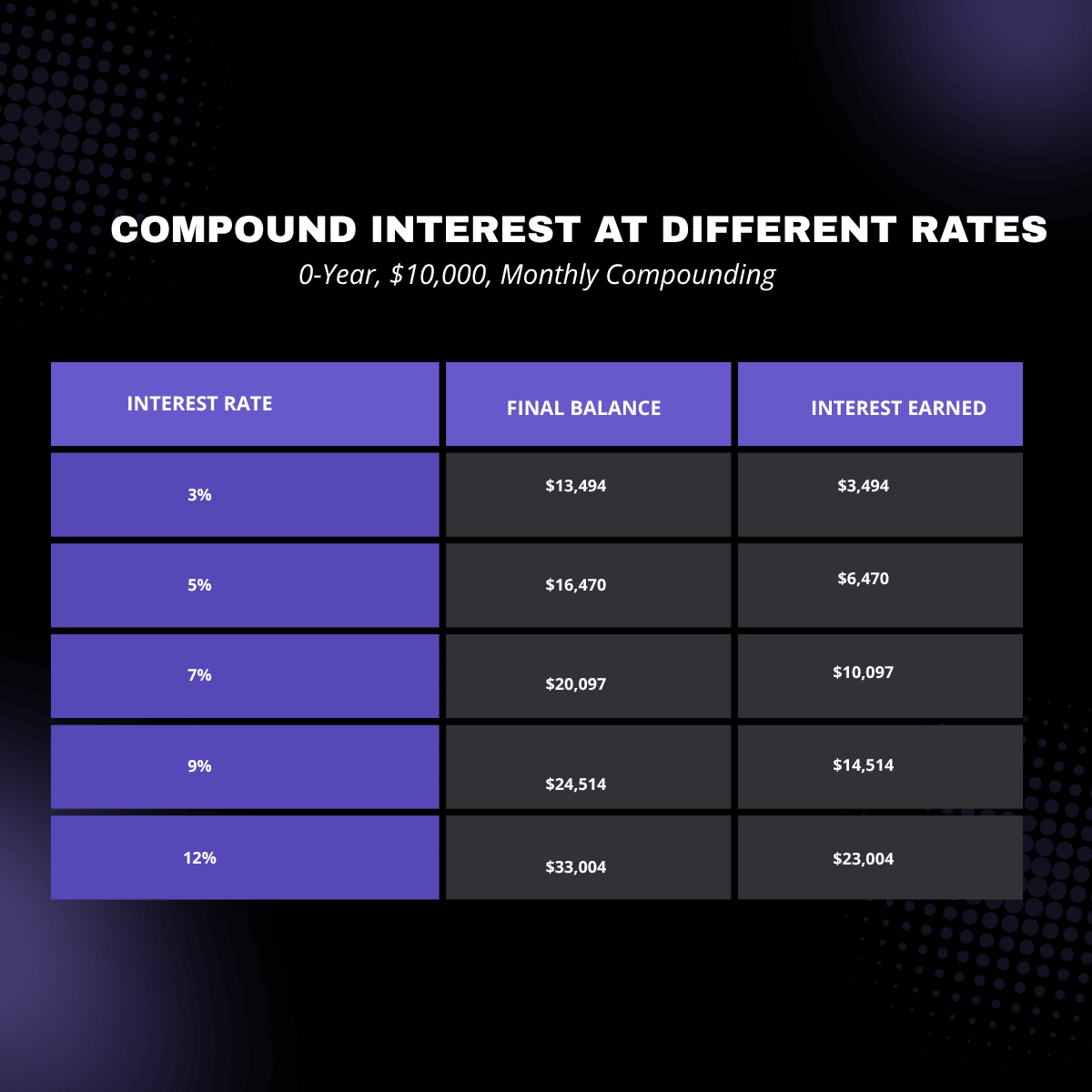
Even a few percentage points of difference compounds into a large gap over a decade. This is why comparing savings account APYs, or fund expense ratios that quietly eat into your effective rate, matters more the longer your money stays invested. Use the CAGR Calculator to compare growth rates across different investments.
Compound Interest With Monthly Contributions
Starting amount isn't the only lever, consistent contributions often matter more over time. Here's $5,000 invested at 7% for 20 years, with and without a $200 monthly contribution:
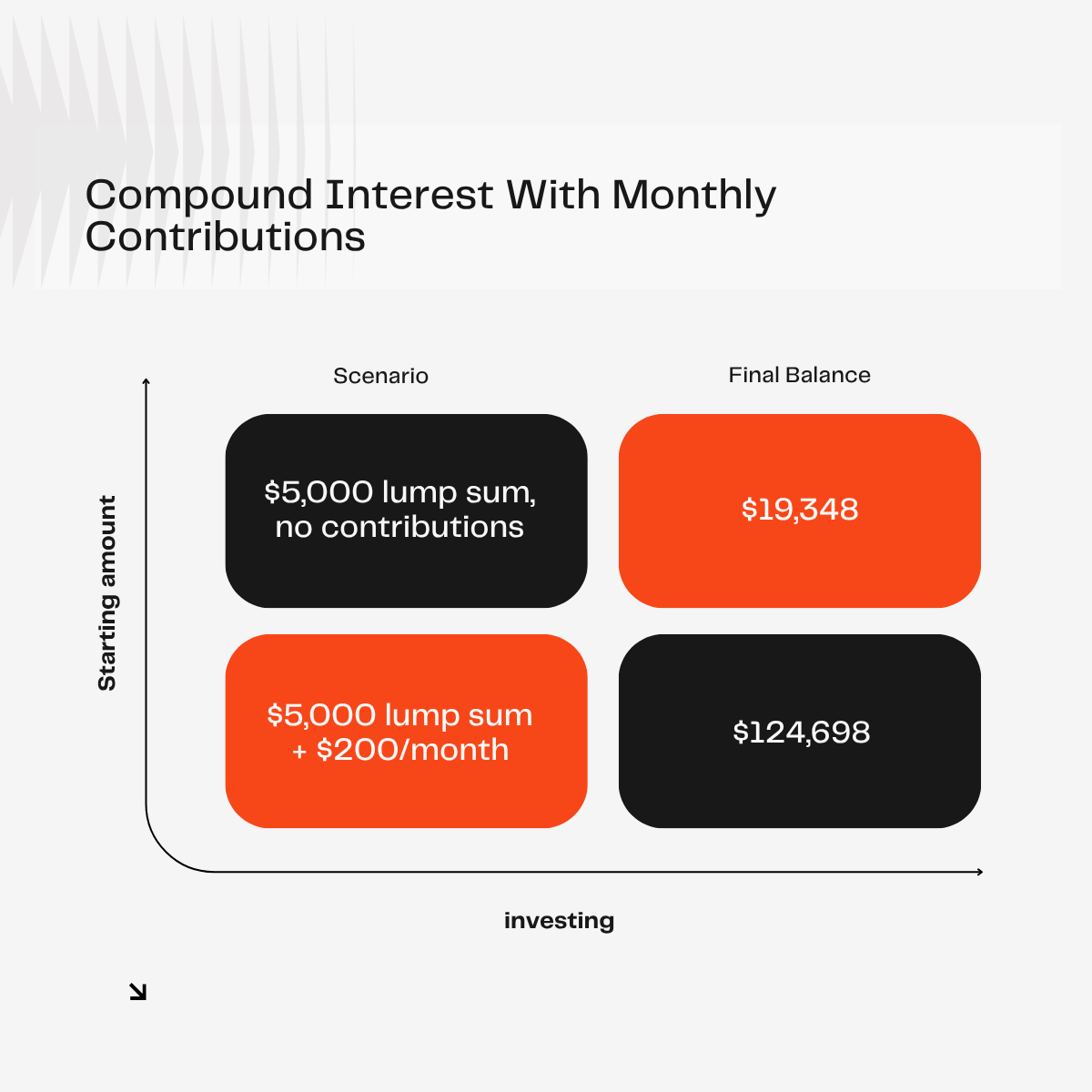
The monthly contributions turn a modest starting balance into a substantially larger outcome, this is the core idea behind most retirement and SIP-style investing strategies. See how this plays out with the SIP Calculator.
Frequently Asked Questions
Simple interest is calculated only on the original principal; every single time, the interest amount never changes. Compound interest grows on top of itself, since interest earns interest. Over long periods the gap becomes dramatic: a $10,000 deposit at 6% simple interest for 20 years gives you $22,000 total. Compounded monthly, that same deposit grows to about $33,100, roughly 50% more, purely from the compounding effect.
More frequent compounding always helps, but the gains shrink fast after a certain point. Daily compounding beats monthly by a small margin, and monthly beats annual by a bit more, but the jump from annual to monthly compounding matters more than the jump from monthly to daily. On $10,000 at 6% for 10 years: annual compounding gives $17,908, monthly gives $18,194, and daily gives $18,220. Rate and time period matter far more than compounding frequency, so don't let this decision distract from finding a better rate or investing for longer.
The Rule of 72 is a quick mental shortcut for estimating how long it takes money to double at a given interest rate: divide 72 by the annual rate. At 6% interest, money doubles in about 12 years (72 ÷ 6). At 9%, it takes roughly 8 years. It's not exact, the calculator above gives the precise figure, but it's a fast way to compare investment options in your head.
Yes, compound interest applies to debt the same way it applies to savings. Credit card balances, unpaid loans, and some student loans compound too, which is why balances can grow faster than expected when only minimum payments are made. The same formula that grows your savings can grow what you owe, so it's worth understanding both directions.
No, the result shown is a gross figure based only on principal, rate, time, and compounding frequency. It doesn't subtract taxes on interest earned or adjust for inflation's effect on purchasing power. For a more realistic estimate, subtract your expected tax rate from the interest earned, and remember that inflation (historically around 2-3% annually in the US) reduces the real value of your final balance over long periods.
Before you rely on this result
Results are estimates based on the figures you enter. They exclude fees, taxes and inflation unless stated, and they assume the rate you supply holds for the whole period. For a decision that matters, confirm the numbers with the lender, provider or a qualified adviser.
Related Finance calculators
See all Finance →- Income Tax CalculatorEstimate 2026 US federal income tax with a bracket-by-bracket breakdown.
- CAGR CalculatorCompound Annual Growth Rate — find CAGR, future value, present value, or time to goal.
- Auto Loan CalculatorCar loan calculator with trade-in, down payment, and tax.
- Currency ConverterConvert between 25 major currencies using live exchange rates.
- Freelancer Rate CalculatorCalculate your minimum hourly rate to hit income goals after taxes and expenses.
- Sales Tax CalculatorAdd or remove sales tax with all 50 US state rates.
Guides on this topic
View all posts →Longer reads that explain the method behind the numbers.