How to Calculate EMI: Formula, Examples & EMI Calculator
Learn how to calculate EMI with the formula, examples, and an EMI calculator. Understand how loan amount, interest rate, and tenure affect EMI.
On this page
Planning to take a home loan, car loan, or personal loan? One of the first things you’ll probably want to know is, “How much will I have to pay every month?”
That monthly payment is called an EMI (Equated Monthly Instalment).
Knowing how EMI is calculated can help you compare different loan options and understand how much you’ll actually pay over the full loan period. You don’t always need to do the calculation manually either. An online EMI Calculator can give you a quick estimate by simply entering your loan amount, interest rate, and tenure.
In this guide, we’ll explain how to calculate EMI, what affects your monthly payment, and how you can use an EMI calculator to make loan planning easier.
What Is EMI?
EMI stands for Equated Monthly Instalment. It is the amount you pay to the lender every month until your loan is fully repaid.
An EMI includes two main components:
- Principal: The amount you originally borrowed
- Interest: The amount charged by the lender on the loan
Although the EMI may remain the same throughout the repayment period for a typical fixed-rate loan, the portion going toward principal and interest changes over time.
In the early stages, a larger part of the payment generally goes toward interest. As you continue making payments and the outstanding loan decreases, more of your EMI goes toward the principal.
How Is EMI Calculated?
The standard EMI formula is:
EMI = P × R × (1 + R)ⁿ / [(1 + R)ⁿ − 1]
Here:
- P = Principal loan amount
- R = Monthly interest rate
- N = Total number of monthly installments
If the interest rate is given annually, you need to convert it into a monthly rate before using the formula.
For example, if the annual interest rate is 8.5%, the monthly rate is calculated by dividing the annual rate by 12 and converting the percentage into a decimal.
The total number of installments is also based on the loan tenure. A 5-year loan, for example, has 60 monthly installments.
EMI Calculation Example
Let's say you want to borrow ₹5 lakh with:
- Loan amount: ₹5,00,000
- Annual interest rate: 8.5%
- Loan tenure: 5 years
First, convert the annual interest rate into a monthly rate.
Then calculate the number of monthly payments:
5 × 12 = 60 months
You can then use these figures in the EMI formula to calculate your monthly payment.
While calculating EMI manually is possible, it can become inconvenient when you want to compare several loan options. That's where an EMI calculator can save time.
Use an EMI Calculator for a Quick Estimate
You don't have to work through the formula every time you want to compare a loan.
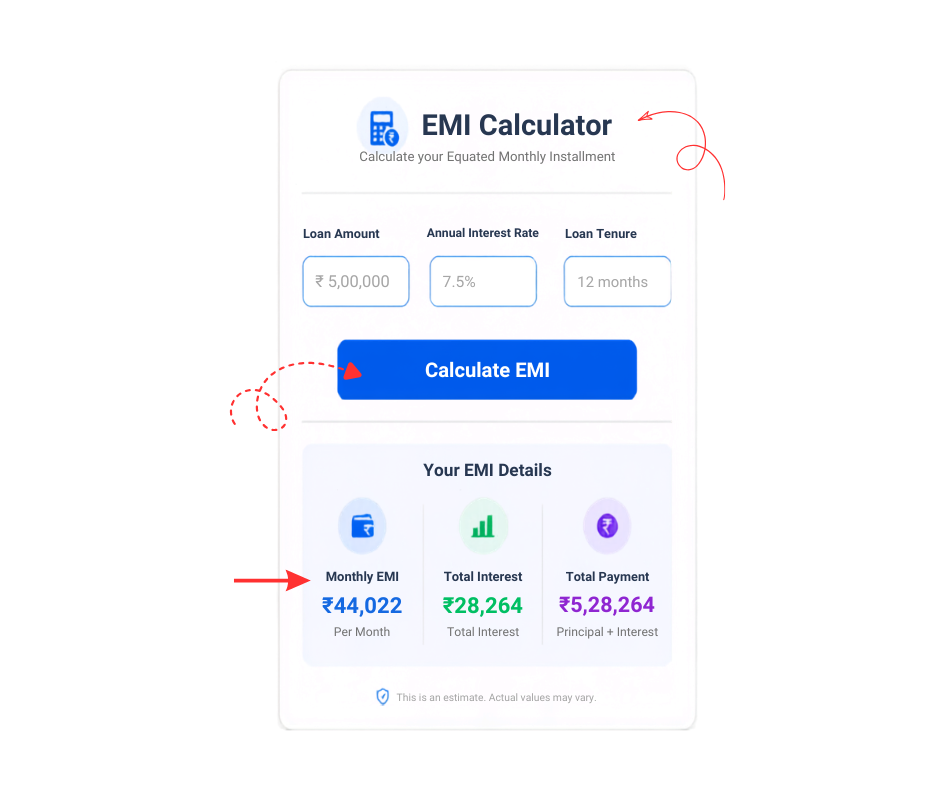
With the CalciHub EMI Calculator, you can enter your loan amount, interest rate, and tenure to estimate your monthly EMI and understand the overall repayment cost.
Try different combinations to see how your EMI changes when you increase the loan amount, change the interest rate, or choose a different repayment period.
What Factors Affect Your EMI?
Your EMI is mainly influenced by three things: the loan amount, interest rate, and loan tenure.
1. Loan Amount
The amount you borrow has a direct effect on your EMI.
If you borrow more while keeping the interest rate and tenure unchanged, your monthly payment will generally be higher.
For example, a ₹10 lakh loan will normally have a higher EMI than a ₹5 lakh loan under the same conditions.
2. Interest Rate
The interest rate also plays an important role.
A higher interest rate generally means a higher EMI and a higher total interest cost, assuming the loan amount and tenure remain the same.
This is why it's useful to compare interest rates when looking at different loan offers.
3. Loan Tenure
Loan tenure is the length of time you have to repay the loan.
Choosing a longer tenure can reduce your monthly EMI because the repayment is spread over more months. However, you may end up paying more interest over the entire loan period.
A shorter tenure usually means a higher monthly EMI but can reduce the total interest you pay.
EMI vs Total Interest: What's the Difference?
Looking only at your monthly EMI doesn't tell you the complete cost of a loan.
Imagine you have two loan options. One has a lower EMI because it comes with a longer repayment period. It may look more affordable each month, but the longer tenure could mean paying significantly more interest over time.
That's why you should compare:
- Monthly EMI
- Total interest
- Total repayment amount
- Loan tenure
A good loan decision isn't just about finding the lowest EMI. It's about finding a repayment plan that fits your budget without unnecessarily increasing your total borrowing cost.
How to Calculate Home Loan EMI
Home loans are usually large and have long repayment periods, so calculating the EMI before applying can be particularly useful.
For example, before choosing a home loan, you can compare how your EMI changes when you:
- Increase the down payment
- Borrow a different amount
- Choose a shorter tenure
- Compare different interest rates
A home loan EMI calculator makes these comparisons much easier.
It can also help you understand how a small change in the interest rate or loan tenure may affect your monthly budget.
How to Calculate Personal Loan EMI
Personal loans are often used for expenses such as education, weddings, medical needs, travel, or other personal requirements.
Before taking one, calculate the expected EMI and check whether it comfortably fits your monthly budget.
A personal loan EMI calculator can help you compare different loan amounts, interest rates, and repayment periods without having to calculate each scenario manually.
How to Calculate Car Loan EMI
Buying a car often involves comparing the down payment, loan amount, interest rate, and repayment tenure.
For example, increasing your down payment reduces the amount you need to borrow. This can reduce your monthly EMI and may also reduce the total interest paid.
Using a car loan EMI calculator before finalising your loan can give you a clearer idea of what the monthly payment may look like.
Is a Lower EMI Always Better?
Not necessarily.
A lower EMI can make your monthly budget easier to manage, but it may come with a longer loan tenure.
And a longer tenure can mean paying interest for more months.
For example, you might have the option of:
Option A: Higher EMI + shorter tenure
Option B: Lower EMI + longer tenure
Option B may feel easier every month, but Option A could potentially cost less in total interest.
The right choice depends on your income, expenses, financial goals, and how comfortably you can manage the monthly payment.
How Can You Reduce Your EMI?
If your EMI is higher than you expected, there are a few things you can consider.
Increase Your Down Payment
For loans such as home or car loans, paying a larger amount upfront reduces the principal you need to borrow.
Compare Interest Rates
Even a small difference in the interest rate can affect your EMI and total interest, particularly for large or long-term loans.
Choose a Suitable Tenure
A longer tenure can reduce the monthly EMI, while a shorter tenure can help reduce the total interest cost.
Instead of choosing the longest or shortest tenure automatically, compare different options and see which one fits your monthly budget.
Why Should You Calculate EMI Before Taking a Loan?
Taking a loan is a long-term financial commitment. Calculating your EMI beforehand gives you a better idea of what you're getting into.
It can help you:
- Plan your monthly budget
- Compare different loan offers
- Understand the impact of interest rates
- Compare different loan tenures
- Estimate the total repayment amount
- Avoid taking a loan that is difficult to manage
A few minutes of calculation before applying for a loan can make the repayment period much easier to plan.
Know Your EMI Before Taking a Loan
Before taking a loan, it's worth knowing what you'll actually be paying every month and how much the loan will cost you in total.
Don't choose a loan just because the EMI looks affordable. Look at the interest rate, tenure, total interest, and total repayment amount as well.
If you want to compare different loan scenarios quickly, use the CalciHub EMI Calculator. It can help you get a clearer picture of your monthly payment and choose a repayment option that works better for your budget.
Frequently Asked Questions About EMI
What is the EMI formula?
The standard EMI formula is based on the principal loan amount, monthly interest rate, and total number of monthly instalments.
EMI = P × R × (1 + R)ⁿ / [(1 + R)ⁿ − 1]
How can I calculate EMI on a loan?
You can calculate EMI manually using the standard EMI formula. Alternatively, you can use an online EMI calculator by entering the loan amount, interest rate, and tenure.
Does a higher loan amount increase EMI?
Yes. If the interest rate and loan tenure remain the same, borrowing a larger amount will generally result in a higher EMI.
Does loan tenure affect EMI?
Yes. A longer tenure generally lowers the monthly EMI because the loan is spread over more payments. However, the total interest paid may be higher.
Does the interest rate affect EMI?
Yes. A higher interest rate generally results in a higher EMI when the loan amount and tenure remain unchanged.
Can I use an EMI calculator for a home loan?
Yes. An EMI calculator can help estimate home loan payments based on the loan amount, interest rate, and repayment tenure.
Is EMI the same throughout the loan?
For a typical fixed-rate loan with a standard amortisation structure, the scheduled EMI generally remains the same. However, the proportion of each payment going toward principal and interest changes over time.
Put this to work
All Finance calculators →Free tools that do the arithmetic in this article for you.
- EMI CalculatorCalculate Equated Monthly Installment for home, car, or personal loans with full schedule.
- SIP CalculatorSystematic Investment Plan — estimate mutual fund SIP returns with year-by-year growth.
- GST CalculatorAdd or remove GST for all Indian tax slabs (5%, 12%, 18%, 28%) with CGST/SGST split.
- YouTube Earnings CalculatorEstimate YouTube ad revenue, sponsorships, and memberships from views and CPM.