
SIP Calculator: How Much Should You Invest Every Month?
Not sure how much you should invest every month through SIP? Learn how a SIP calculator works, compare ₹5,000 and ₹10,000 SIP examples, understand the impact of time and compounding, and find an investment amount that fits your financial goals.
On this page
Not sure how much you should invest every month through SIP? Learn how a SIP calculator works, compare ₹5,000 and ₹10,000 SIP examples, understand the impact of time and compounding, and find an investment amount that fits your financial goals.
How much should you actually invest every month?
₹2,000? ₹5,000? ₹10,000? Or should you invest more if you have a bigger financial goal?
There isn't one SIP amount that works for everyone. Your monthly investment depends on what you're trying to build, how much time you have, and the return you expect from the investment.
A SIP calculator can make this easier. Instead of guessing, you can change the monthly investment, investment period and expected return to see how your money could potentially grow over time.
What Is a SIP Calculator?
A SIP calculator is a tool that estimates the future value of regular monthly investments.
You enter a few basic details:
- Monthly investment amount
- Expected annual return
- Investment duration
The calculator then gives you an estimate of:
- Total amount invested
- Estimated returns
- Total value of your investment
For example, suppose you invest ₹5,000 every month for 10 years. You can use a SIP calculator to estimate how much you might have at the end of that period based on an assumed rate of return.
The important word here is estimate.
A SIP calculator doesn't predict what the market will actually do. Mutual fund returns are market-linked, so the final value can be higher or lower than the estimate.
How Does a SIP Calculator Work?
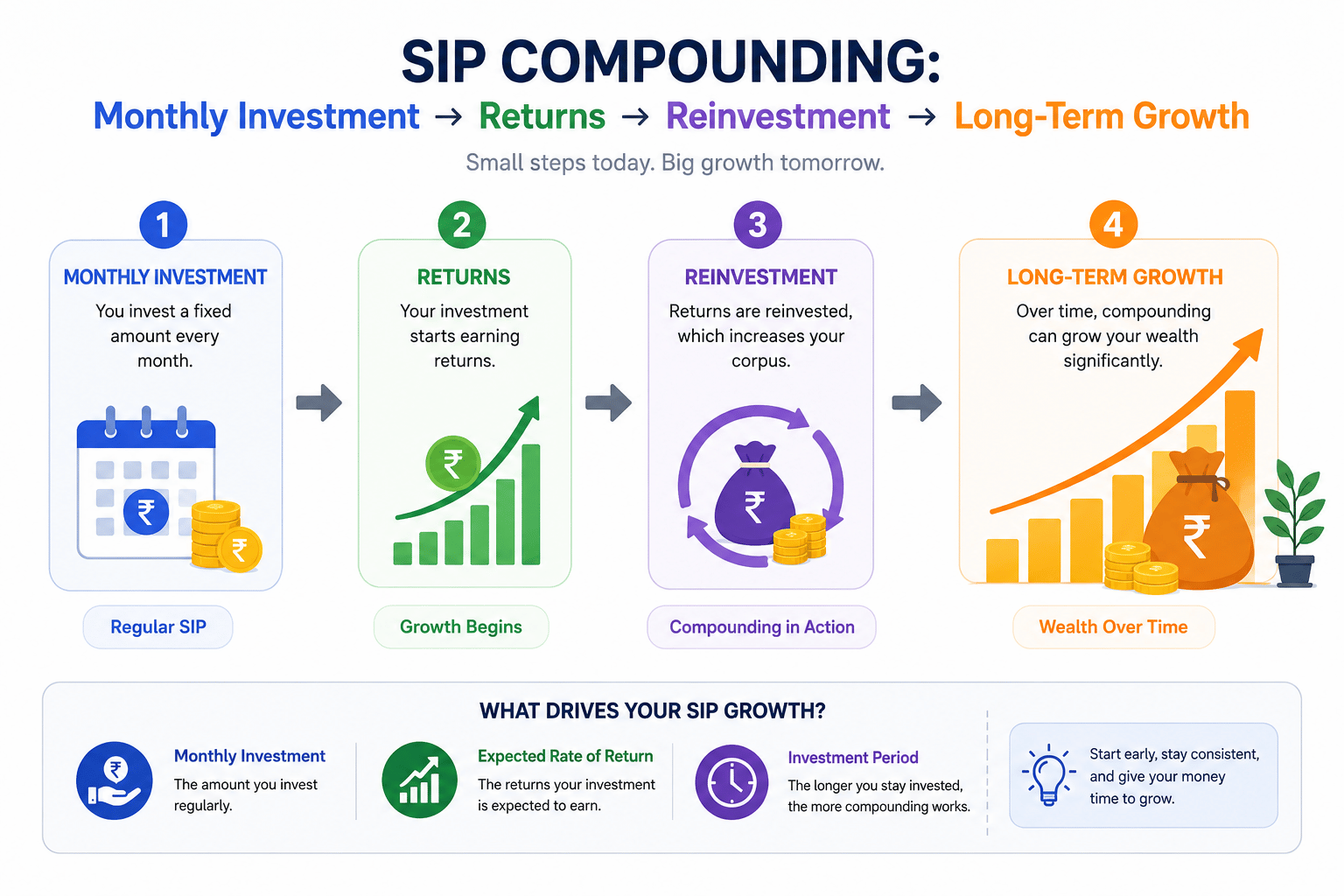
A SIP works through regular investments and compounding over time.
You invest a fixed amount at regular intervals rather than putting the entire amount in at once. As the investment grows, the returns can themselves contribute to future growth.
For a simplified illustration, the future value of a regular SIP depends mainly on:
Monthly investment + expected rate of return + investment period
The longer your money stays invested, the more time compounding has to work.
How Much Should You Invest in SIP Every Month?
This is probably the most useful question a SIP calculator can help you answer.
Rather than choosing an amount randomly, start with your goal.
Goal: Build a long-term investment corpus
Now ask:
- How much money do I want to build?
- When will I need it?
- How much can I comfortably invest every month?
- Can I increase the SIP amount in the future?
Someone who has 20 years to invest may need a different monthly amount than someone trying to reach the same goal in 7 years.
That's why simply asking “Is ₹5,000 SIP enough?” doesn't have a universal answer.
It depends on the goal and the time available.
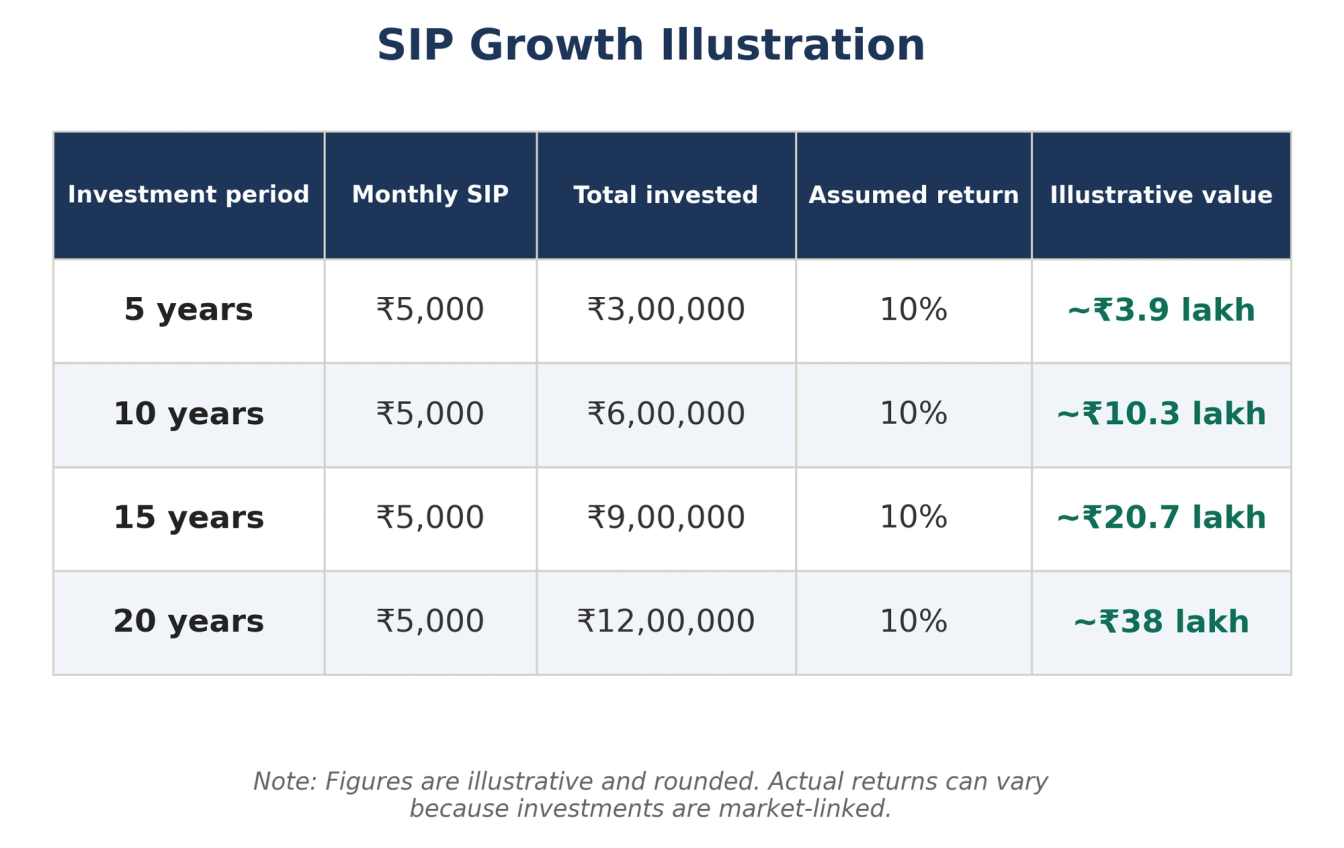
₹5,000 SIP for 10 Years: How Much Can It Grow?
Let's take a simple example.
Suppose you invest ₹5,000 every month for 10 years.
₹5,000 × 12 × 10 = ₹6,00,000
The final value, however, depends on the return generated by the investment.
For illustration, assuming an annual return of 10%, the estimated value would be around ₹10.3 lakh.
That means a significant part of the final value comes from investment growth rather than just your monthly contributions.
But remember: 10% is an illustration, not a guaranteed return.
This is where a SIP returns calculator becomes useful. You can change the assumptions instead of relying on one example.
What If You Invest ₹10,000 Every Month?
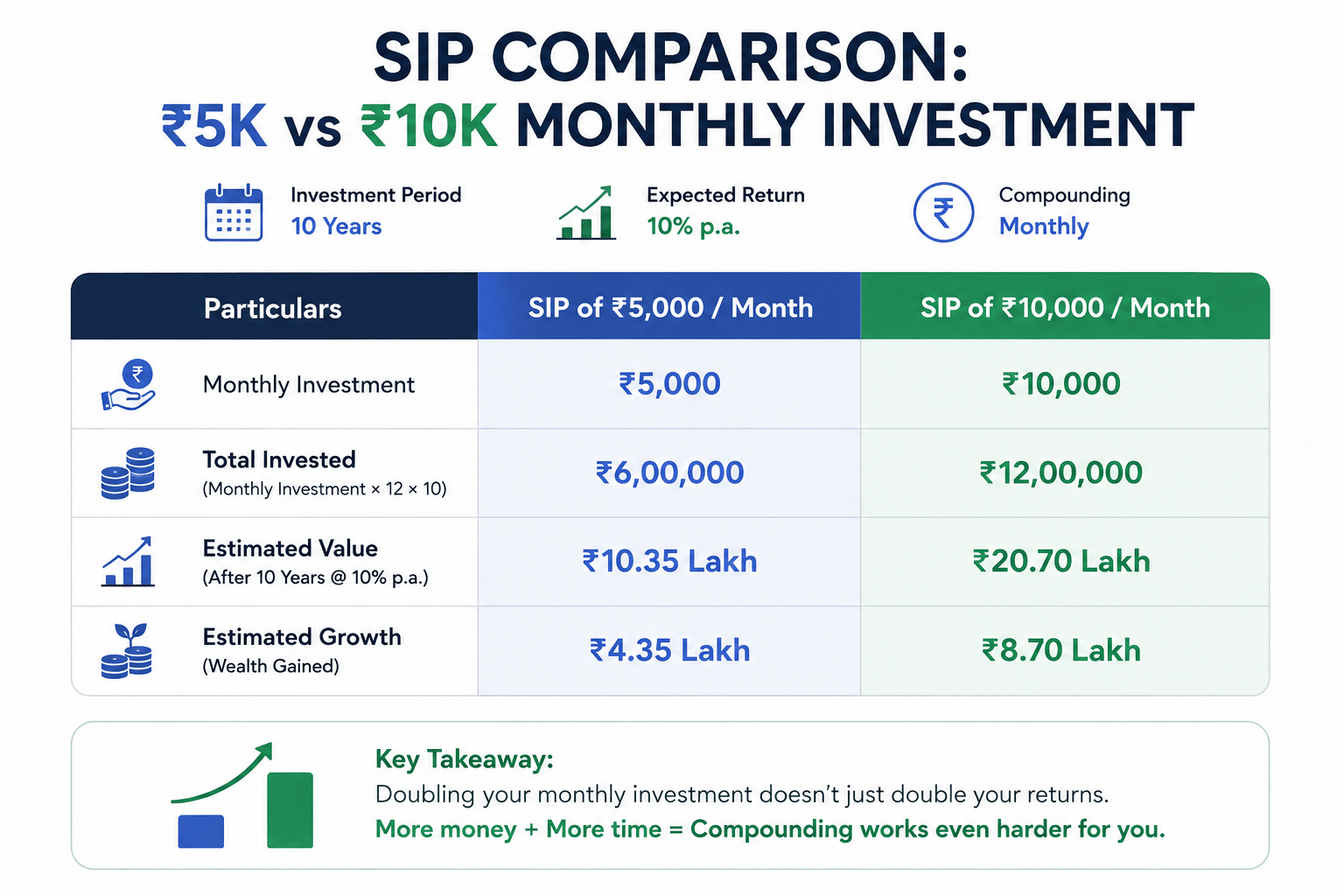
Let's double the monthly SIP.
If you invest ₹10,000 per month for 10 years, your total contribution becomes:
₹10,000 × 12 × 10 = ₹12,00,000
Using the same 10% annual return assumption, the estimated final value would be roughly ₹20.7 lakh.
The difference is not only because you invested twice as much.
The additional money also gets an opportunity to compound over the same period.
Does Investing for Longer Make a Difference?
Yes — and this is one of the biggest reasons investors use SIPs for long-term goals.
Consider a ₹5,000 monthly SIP.
Your monthly contribution remains exactly the same. What changes is the amount of time your money has to remain invested.
That's where compounding becomes increasingly important.
For a long-term investor, increasing the investment period can sometimes have a bigger impact than simply trying to chase a higher return.
This doesn't mean longer investment periods automatically guarantee profits. Markets can rise and fall, and returns are never fixed.
It simply means time gives compounding more opportunity to work.
What Factors Should You Consider Before Choosing Your SIP Amount?
Before entering a number into a monthly SIP calculator, think about these five things.
1. Your financial goal
Are you investing for a house, education, retirement, a future business, or simply long-term wealth creation? Your goal gives the SIP a purpose.
2. Your investment time frame
A 5-year goal and a 20-year goal require very different planning. Don't choose a SIP amount without considering when you'll need the money.
3. Your monthly cash flow
Your SIP should be an amount you can maintain comfortably. Starting with ₹20,000 and stopping after three months isn't necessarily better than starting with ₹5,000 and consistently investing for years.
4. Expected return
A SIP calculator needs an assumed return to create an estimate. Use a reasonable assumption rather than choosing an unusually high number simply because the final result looks attractive.
5. Your ability to increase the investment
Your income may increase over time. A SIP that starts at ₹5,000 doesn't necessarily have to stay at ₹5,000 forever. Increasing the investment periodically can help you put more money toward long-term goals.
What Is a Step-Up SIP?
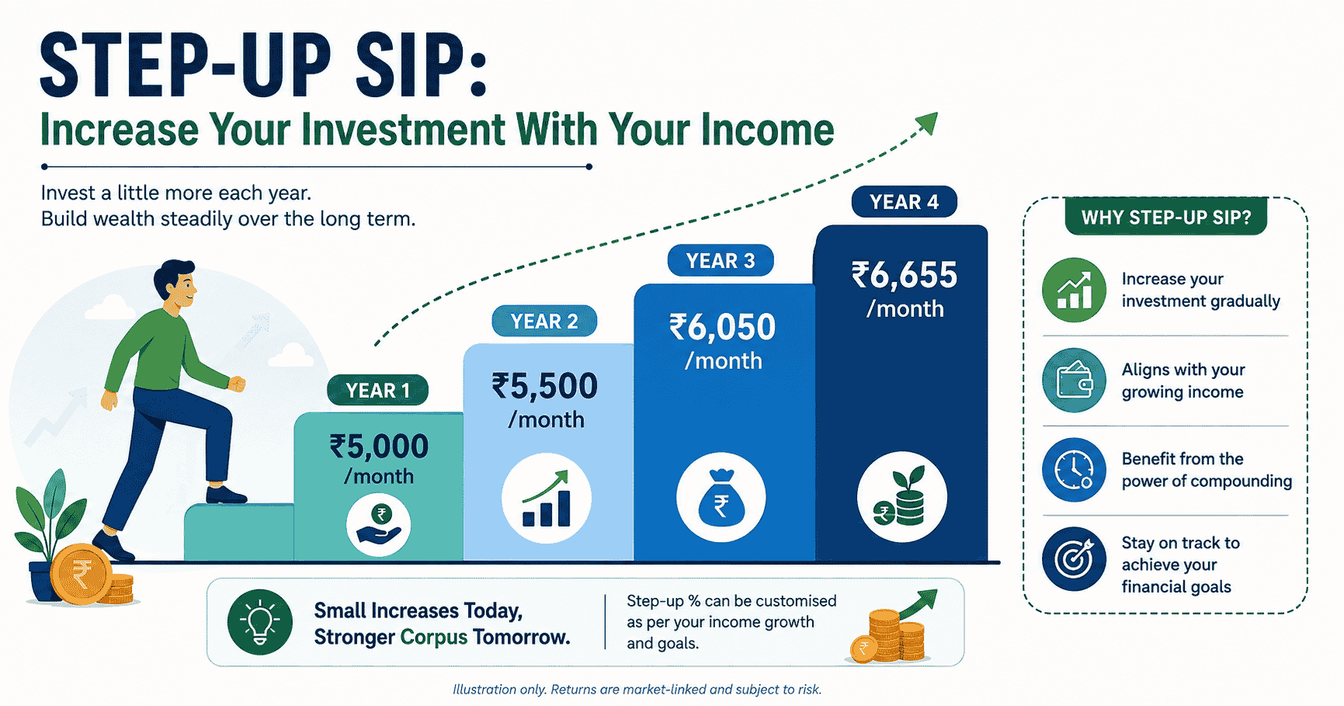
A step-up SIP is a SIP where you increase your investment amount periodically.
Year 1: ₹5,000/month
Year 2: ₹5,500/month
Year 3: ₹6,050/month
Year 4: ₹6,655/month
The exact increase depends on your chosen step-up percentage.
This approach can make sense for people whose income is expected to grow over time.
SIP vs Lump Sum: What's the Difference?
With a lump-sum investment, you invest a larger amount at one time.
With SIP, you invest smaller amounts regularly.
Neither approach is automatically better in every situation.
The choice depends on your available money, investment objective, market conditions, risk tolerance and time horizon.
A SIP can be convenient for people who receive income regularly and want to invest a fixed amount every month.
A lump-sum approach may be relevant when you already have a larger amount available for investment.
If you're comparing the two, don't look only at the final number. Consider how the money enters the market and what you're comfortable with.
How to Use a SIP Calculator
Using a SIP investment calculator is fairly straightforward.
Step 1: Enter your monthly investment
Start with an amount you can realistically invest every month.
Step 2: Enter your expected return
Use an assumption that is reasonable for your calculation.
Step 3: Select your investment period
Enter the number of years you expect to stay invested.
Step 4: Check the estimated value
The calculator will show your total investment and estimated growth.
Step 5: Try different scenarios
Try ₹5,000 vs ₹10,000 monthly, 10 years vs 15 years, different return assumptions, and a higher SIP amount over time.
Instead of asking “How much will I get?”, you can start asking a better question:
“What investment plan fits my goal?”
Is a SIP Calculator Accurate?
A SIP calculator is accurate at doing the mathematical calculation based on the numbers you provide.
But it cannot guarantee the actual future value of a market-linked investment.
For example, if you enter a 10% expected return, the calculator uses that assumption to estimate the result.
The actual investment may perform differently.
So treat the output as a planning estimate, not a promise.
This distinction is especially important when you're planning for long-term financial goals.
Common SIP Mistakes to Avoid
Choosing a SIP amount just because someone else uses it
Your friend's ₹10,000 SIP may be right for them and completely wrong for you. Start with your own income, expenses and goals.
Focusing only on returns
A higher assumed return can make the final number look much better on a calculator. That doesn't make the assumption realistic.
Stopping when markets fall
SIP investors will experience periods when the market is down. Short-term fluctuations are part of market-linked investing. Your investment decision should be based on your overall plan rather than one bad month.
Ignoring inflation
₹20 lakh today won't have the same purchasing power many years from now. When setting a long-term target, think about what that money will actually be worth in the future.
Never increasing the SIP
If your income grows but your SIP stays unchanged for years, you may be missing an opportunity to invest more toward your goals.
So, How Much Should You Invest Every Month?
There isn't a magic SIP amount.
For one person, ₹3,000 may be a comfortable starting point. For another, ₹30,000 may fit their income and financial goals.
The better approach is to work backwards:
Financial Goal → Time Horizon → Required Corpus → Monthly Investment
A SIP calculator can help you test different combinations and understand what may be possible.
Start with an amount you can sustain. Then review it as your income, expenses and goals change.
Frequently Asked Questions
Is ₹5,000 enough for a SIP?
It can be a reasonable starting amount for some investors, but whether it is enough depends on your financial goal, investment period and expected returns.
How much can ₹10,000 SIP become in 10 years?
The final amount depends on the investment return. With an illustrative 10% annual return assumption, ₹10,000 invested monthly for 10 years could grow to roughly ₹20.7 lakh. Actual returns can be different.
Can I increase my SIP every year?
Yes. Increasing your SIP periodically is commonly known as a step-up SIP. It can help you invest more as your income increases.
Is SIP return guaranteed?
No. SIP itself is an investment method, not a guaranteed-return product. Returns depend on the underlying investment and market performance.
Is a SIP calculator useful for financial planning?
Yes. It can help you compare different monthly investment amounts, time periods and return assumptions. However, the result should be treated as an estimate rather than a guaranteed future value.
Should I invest ₹5,000 or ₹10,000 in SIP?
Choose an amount that fits your financial situation and goal. If both are affordable, use a SIP calculator to compare how the different contributions could affect your estimated future value.
Final Takeaway
A SIP doesn't have to start with a huge amount.
What matters is having a clear goal, choosing an amount you can maintain, and giving your investment enough time to potentially benefit from compounding.
Before deciding your monthly amount, run a few scenarios through a SIP calculator.
Try ₹5,000. Then ₹10,000. Change the investment period. Adjust the return assumption.
The goal isn't to find a number that looks impressive on a screen.
It's to find an investment amount that makes sense for your own financial goal.
Put this to work
All Finance calculators →Free tools that do the arithmetic in this article for you.
- EMI CalculatorCalculate Equated Monthly Installment for home, car, or personal loans with full schedule.
- SIP CalculatorSystematic Investment Plan — estimate mutual fund SIP returns with year-by-year growth.
- GST CalculatorAdd or remove GST for all Indian tax slabs (5%, 12%, 18%, 28%) with CGST/SGST split.
- YouTube Earnings CalculatorEstimate YouTube ad revenue, sponsorships, and memberships from views and CPM.