Percentage Calculator: How to Calculate Percentages Easily
Learn how to calculate percentages with simple formulas and examples. Find percentage increase, decrease, and more using easy calculation methods.
On this page
Percentages are everywhere. From calculating discounts while shopping to checking exam scores, comparing prices, understanding business growth, or working out how much a number has increased or decreased, we use percentages almost every day.
The good news is that percentage calculations do not have to be complicated. With the right formula, you can calculate percentages in just a few steps. And when you need a quick answer, a Percentage Calculator can do the calculation for you instantly.
In this guide, we will explain what a percentage means, how to calculate it, the most common percentage formulas, and when an online percentage calculator can be useful.
What Is a Percentage?
A percentage is a way of expressing a number as a fraction of 100. The word "percent" literally means "per hundred."
For example:
- 10% means 10 out of 100
- 25% means 25 out of 100
- 50% means 50 out of 100
- 75% means 75 out of 100
So, if 25 students out of a class of 100 passed an exam, the passing percentage is 25%.
Percentages make it easier to compare numbers because everything is represented on the same scale of 100.
How to Calculate a Percentage
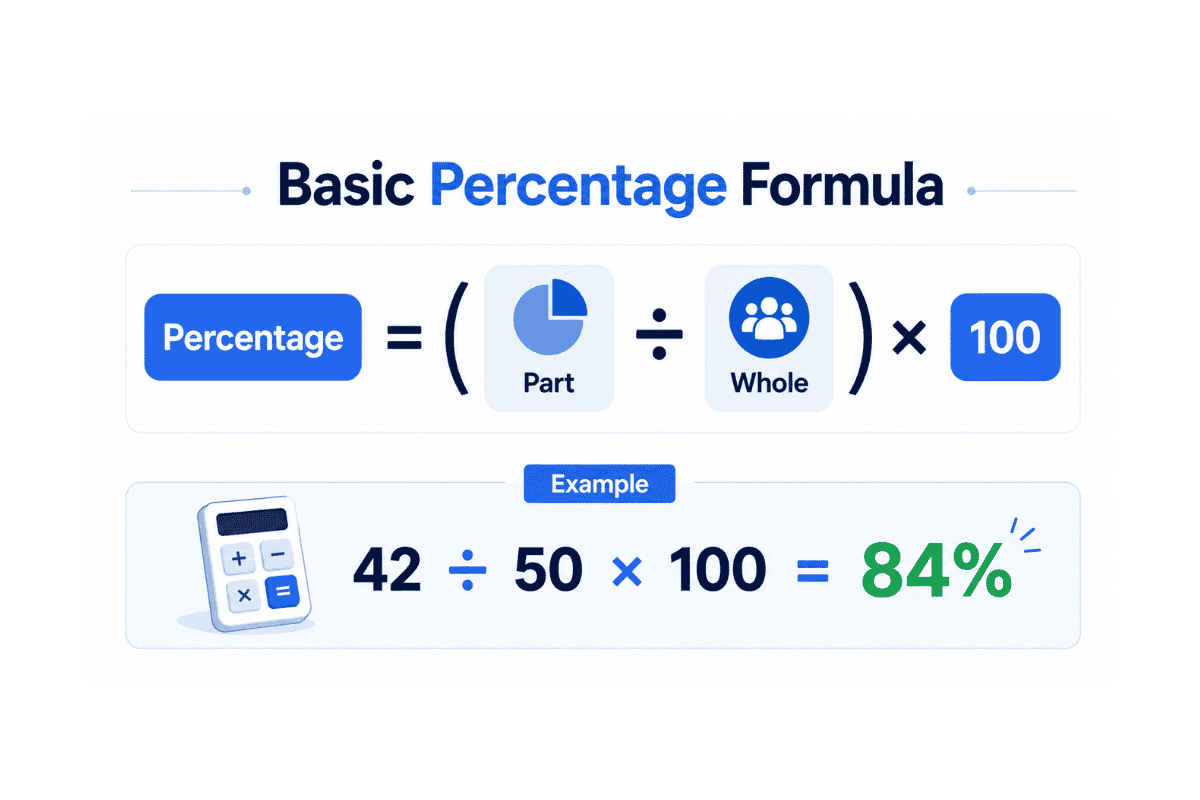
The basic percentage formula is simple:
Percentage = (Part ÷ Whole) × 100
For example, suppose you scored 42 marks out of 50.
Using the formula:
Percentage = (42 ÷ 50) × 100
Percentage = 84%
So, your score is 84%.
This same formula can be used for marks, survey results, sales figures, attendance, expenses, and many other everyday calculations.
How to Find the Percentage of a Number
Sometimes, you may want to find a particular percentage of a number.
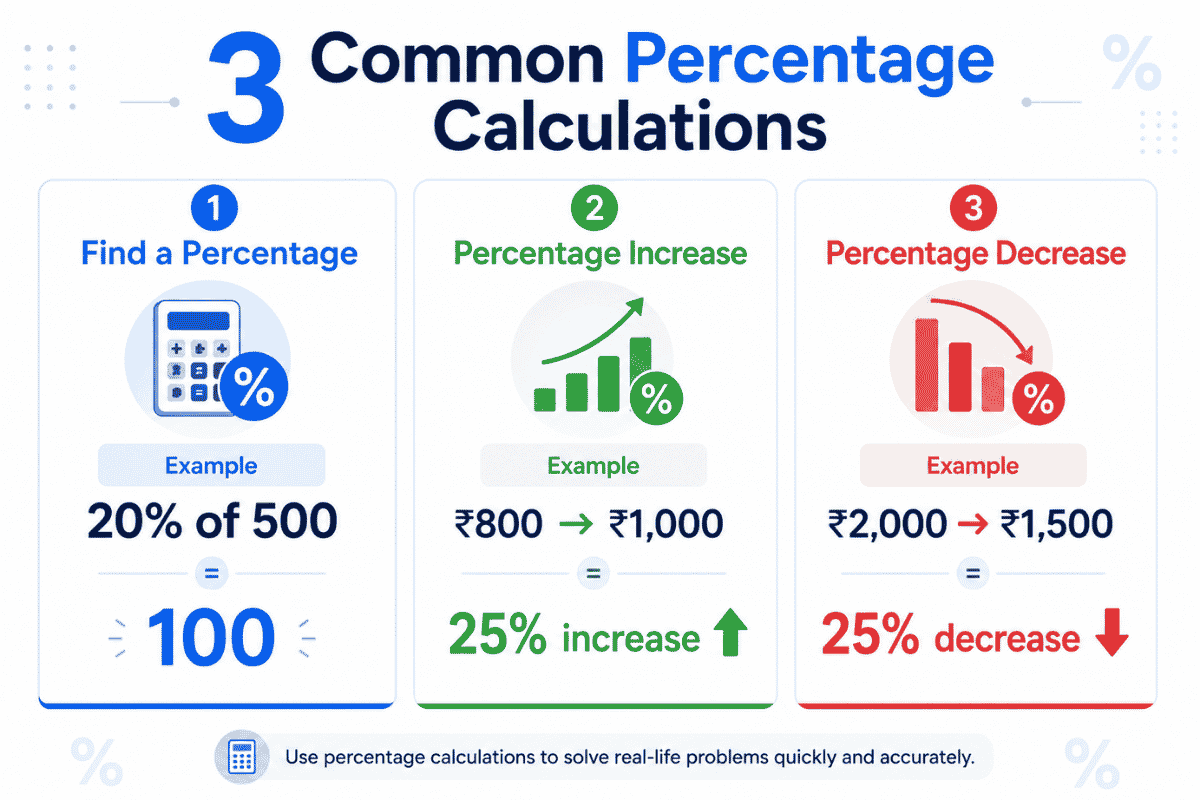
For example, what is 20% of 500?
First, convert 20% into a decimal:
20 ÷ 100 = 0.20
Then multiply it by 500:
0.20 × 500 = 100
Therefore, 20% of 500 is 100.
You can also use this calculation directly:
(20 ÷ 100) × 500 = 100
An online Percentage Calculator makes this type of calculation much faster, especially when you are working with large or decimal numbers.
How to Calculate Percentage Increase
Percentage increase tells you how much a value has increased compared with its original value.
The formula is:
Percentage Increase = ((New Value − Original Value) ÷ Original Value) × 100
For example, imagine the price of a product increased from ₹800 to ₹1,000.
The increase is:
₹1,000 − ₹800 = ₹200
Now calculate:
₹200 ÷ ₹800 × 100 = 25%
So, the price increased by 25%.
Percentage increase is commonly used for salary changes, product prices, sales growth, investments, website traffic, and business performance.
How to Calculate Percentage Decrease
Percentage decrease works in a similar way. It tells you how much a value has fallen compared with its original value.
The formula is:
Percentage Decrease = ((Original Value − New Value) ÷ Original Value) × 100
For example, a product originally costs ₹2,000 but is now available for ₹1,500.
The decrease is:
₹2,000 − ₹1,500 = ₹500
Now:
₹500 ÷ ₹2,000 × 100 = 25%
The price has therefore decreased by 25%.
This calculation is particularly useful when comparing discounts, price reductions, expenses, or changes in business figures.
How to Find What Percentage One Number Is of Another
Another common question is, "What percentage is one number of another?"
For example, you have 30 apples, and 12 of them are red. What percentage of the apples are red?
Use:
(12 ÷ 30) × 100 = 40%
Therefore, 40% of the apples are red.
This method is useful for calculating survey responses, attendance, test results, sales conversions, and other ratios.
Percentage Calculator vs Manual Calculation
Knowing the percentage formula is useful because it helps you understand how the answer is calculated. However, manually calculating percentages can become time-consuming when the numbers are complicated.
An online percentage calculator can help when you need quick results without doing the calculation step by step.
It can be especially useful for:
- Calculating discounts
- Comparing prices
- Checking exam marks
- Finding percentage increases
- Finding percentage decreases
- Calculating business growth
- Comparing expenses
- Understanding survey results
- Working out everyday percentages
For simple calculations, mental maths may be enough. But for repeated calculations or numbers with decimals, using an online tool can save time and reduce calculation mistakes.
Common Percentage Mistakes to Avoid
Percentage calculations are easy once you understand the basic idea, but a few common mistakes can lead to incorrect results.
Using the wrong original value
When calculating percentage increase or decrease, the original value is normally used as the denominator.
Forgetting to multiply by 100
If you calculate Part ÷ Whole and stop there, you have a decimal or fraction, not the percentage.
Confusing percentage points with percentage change
A change from 20% to 30% is a 10 percentage-point increase, but the relative percentage increase is 50%.
Understanding this difference is important when working with statistics, business data, and financial information.
Why Use an Online Percentage Calculator?
The biggest advantage of an online calculator is convenience. Instead of remembering several formulas, you can enter the numbers and get the result quickly.
It is also helpful when you are checking an answer or working with calculations that involve several decimal places.
For students, professionals, business owners, shoppers, and anyone dealing with numbers regularly, a Percentage Calculator can be a handy everyday tool.
Frequently Asked Questions
What is the basic percentage formula?
The basic formula is:
Percentage = (Part ÷ Whole) × 100
How do I calculate 10% of a number?
Divide the number by 10. For example, 10% of 700 is 70.
How do I calculate percentage increase?
Subtract the original value from the new value, divide the difference by the original value, and multiply by 100.
How do I calculate percentage decrease?
Subtract the new value from the original value, divide the difference by the original value, and multiply by 100.
Is an online percentage calculator accurate?
A properly designed calculator can perform the mathematical calculation quickly and consistently. It is still a good idea to understand the formula so you can check whether the input values are correct.
Final Thoughts
Percentages may look complicated when you first see different formulas for increase, decrease, discounts, ratios, and comparisons. But the underlying idea is quite simple: a percentage tells you how much something represents out of 100.
Once you understand the basic percentage formula, many everyday calculations become easier. And when you want a quick answer, an online Percentage Calculator can save time and make the process much more convenient.
Whether you are checking your exam score, calculating a discount, comparing prices, or measuring growth, knowing how to work with percentages is a useful skill that you can use almost every day.
Put this to work
All Mathematics calculators →Free tools that do the arithmetic in this article for you.
- Basic CalculatorPerform simple arithmetic calculations with ease.
- Percentage CalculatorCalculate percentages, increases, decreases, and more.
- Scientific CalculatorAdvanced calculator with trigonometry, logarithms, and constants.
- Random Number GeneratorGenerate random numbers, integers, or sequences within any range.