FIRE Calculator
Find your FIRE number and see how many years it could take to reach financial independence. Enter your savings, income and spending to get a clear target and date.
Your FIRE Number
$1,000,000
FIRE at age 41.3 in 13.3 years
Annual Savings
$40,000
Years to FIRE
13.3 yr
Retirement Years
49 yr
What is a FIRE calculator?
FIRE means Financial Independence, Retire Early. A FIRE calculator shows how big your investment portfolio needs to be so you can live off it, and roughly how long it will take to get there. It uses your age, current savings, income, savings rate, retirement spending, expected return and withdrawal rate. The result is a target number and a timeline you can plan around.
What is a FIRE number?
Your FIRE number is the portfolio size that could cover your yearly spending for the rest of your life. It is based on the 4% rule: if you withdraw 4% of your portfolio each year, you need 25 times your yearly spending.
How to use this calculator
- Enter your current age.
- Enter your current savings or portfolio value.
- Enter your annual income and choose a savings rate. The calculator turns these into your yearly savings.
- Enter the annual expenses you expect in retirement.
- Set your expected market return and a safe withdrawal rate (4% is the classic starting point).
- Press Calculate FIRE Date to see your FIRE number, your age at FIRE and the years to get there.
The fields start with example values. Replace them with your own.
The formulas
- FIRE number = annual retirement expenses ÷ withdrawal rate
- Yearly savings = annual income × savings rate
- Years to FIRE = the time it takes for your savings plus yearly contributions, growing at your expected return, to reach the FIRE number
The calculator assumes your yearly savings are added in equal monthly amounts, and your investments grow with monthly compounding.
Example: the calculator’s starting values
Age 28, $50,000 saved, $80,000 income, 50% savings rate, $40,000 retirement spending, 7% return, 4% withdrawal rate.
- FIRE number: $40,000 ÷ 0.04 = $1,000,000
- Yearly savings: $80,000 × 50% = $40,000
- Time to FIRE: about 13.3 years, so around age 41
How your choices change the result
Same example, one change at a time:
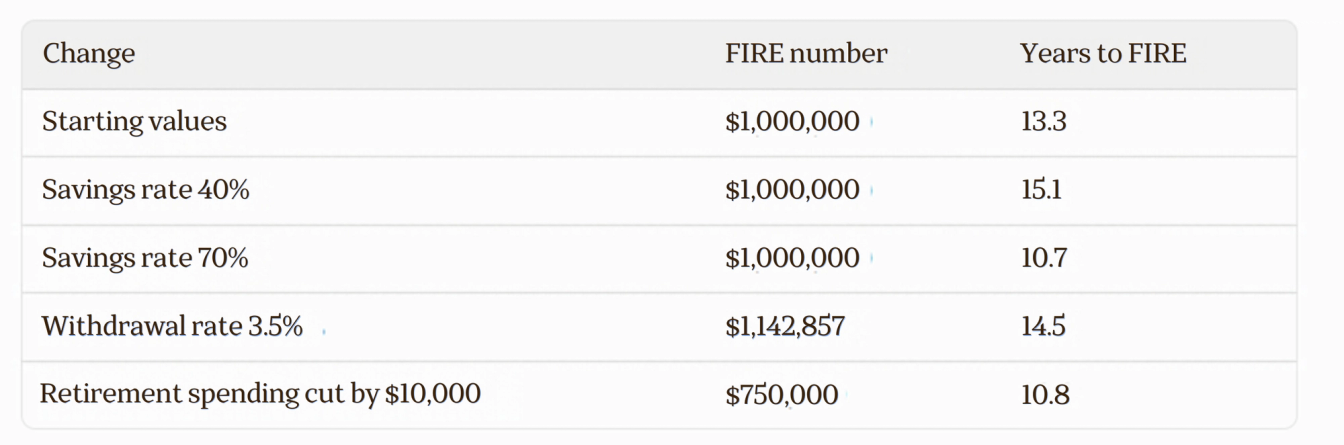
Saving more and spending less help at the same time. They raise your yearly savings and lower the target.
How the withdrawal rate changes your FIRE number
With $40,000 of yearly spending:
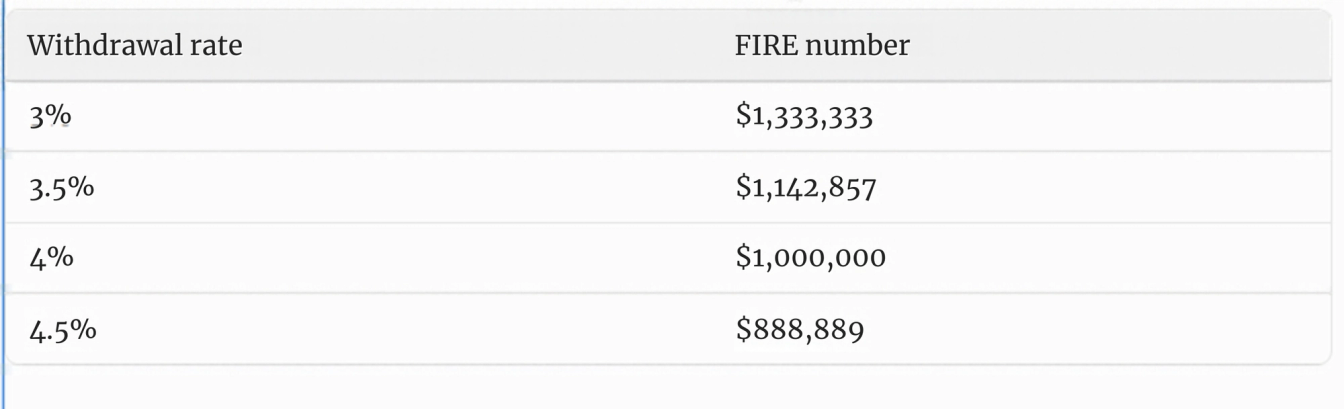
A lower rate is more cautious and needs a bigger portfolio. People who plan to retire very early often choose a lower rate because their money must last longer.
Use a realistic return
If you enter spending in today’s dollars, a return of 7% before inflation can make your timeline look too fast. A return after inflation, such as 5%, is more careful. With 5%, the starting example takes about 15.0 years instead of 13.3.
What this calculator does not include
- Inflation (unless you enter an after-inflation return)
- Taxes on withdrawals
- Early withdrawal penalties on retirement accounts
- Health care costs
- Social Security or pensions
- Market ups and downs. Real returns will not be smooth.
Frequently Asked Questions
It says you can withdraw 4% of your portfolio in the first year of retirement, then adjust for inflation each year, and your money has a good chance to last about 30 years. It came from William Bengen’s 1994 research and was supported by the 1998 Trinity Study. It is a guideline, not a guarantee.
It depends on how long you need the money to last and how markets perform. Many planners suggest a lower rate, around 3.25% to 3.5%, for retirements of 40 years or more. Use a rate you are comfortable with.
Divide your yearly retirement spending by your withdrawal rate. At 4%, that means multiplying your spending by 25. If you expect to spend $40,000 a year, your FIRE number is $1,000,000.
A lot. Saving more shortens the time you need to build your portfolio, and spending less also lowers your target. In the table above, going from 40% to 70% saved cuts about 4 years from the timeline.
LeanFIRE means retiring on a low, simple budget. FatFIRE means retiring on a higher budget with more spending room. Regular FIRE sits in between. There are no official dollar cutoffs, so choose the lifestyle you want and enter its cost.
You can, but be careful. Benefits depend on your work history, and early retirees may have fewer years of earnings. Check your own estimate at ssa.gov before counting on it. Leaving it out makes your plan more cautious.
It is the risk of bad market returns in the first years of retirement. Withdrawing while prices are low can hurt your portfolio more than the same losses later on. Flexible spending and a lower withdrawal rate can help.
No. Enter an after-inflation return to account for inflation, and consider taxes and account rules separately.
Before you rely on this result
The 4% withdrawal rule came from a study of a specific historical period and market, and is a rule of thumb rather than a guarantee. Poor returns in the first few years of retirement do disproportionate damage, because withdrawals sell more units while prices are low.
Related Finance calculators
See all Finance →- Paycheck CalculatorEstimate net take-home pay after federal, state taxes, and deductions.
- Amortization CalculatorFull loan amortization schedule with optional extra payments.
- Work From Home SavingsCalculate money and time saved by working from home vs commuting to office.
- Tip SplitterSplit the bill and tip evenly or by custom amounts per person.
- Simple Interest CalculatorCalculate simple interest on a principal amount.
- Credit Card Payoff CalculatorSee how long to pay off credit card debt and interest saved.
More from Finance
View all posts →Longer reads from our finance collection.