Work From Home Savings Calculator
Find out how much money and time you save by working from home. Enter your commute, fuel, parking and daily spending, and get your yearly net savings in seconds.
Annual Gross Savings
$8,846.15
WFH Extra Costs
$600.00
Net Annual Savings
$8,246.15
Time saved: 333 hours/year (41.7 full work days)
| Category | Per WFH Day | Per Year |
|---|---|---|
| Gas / Fuel | $5.00 | $1,250.00 |
| Parking | $10.00 | $2,500.00 |
| Lunch out | $15.00 | $3,750.00 |
| Coffee | $5.00 | $1,250.00 |
| Work Attire | $0.38 | $96.15 |
What is a work from home savings calculator?
A work from home savings calculator estimates how much money you keep when you skip the daily trip to the office. It adds up costs you avoid, like fuel, parking, lunch, coffee and work clothes. It then subtracts the extra costs of working at home. The result is your net yearly savings, plus the hours you get back from not commuting.
How to use this calculator
- Choose how many days you work at the office each week.
- Choose how many days per week you work from home (the “WFH days saved”).
- Enter your one-way commute in miles, your car’s fuel efficiency (MPG) and the current gas price.
- Add your daily parking, lunch and coffee or snack costs.
- Enter what you spend on work clothes each year.
- Press Calculate Savings to see your gross savings, extra home costs and net savings.
The fields start with example values. Replace them with your own numbers for a result that fits your life.
The formula behind the result
- Daily fuel cost = (one-way miles × 2 ÷ MPG) × gas price
- Savings per WFH day = fuel + parking + lunch + coffee + work clothes (per day)
- Annual gross savings = savings per WFH day × number of WFH days in the year
- Net annual savings = annual gross savings − extra costs of working from home.
Example: a full-time remote worker
Using the calculator’s starting values:
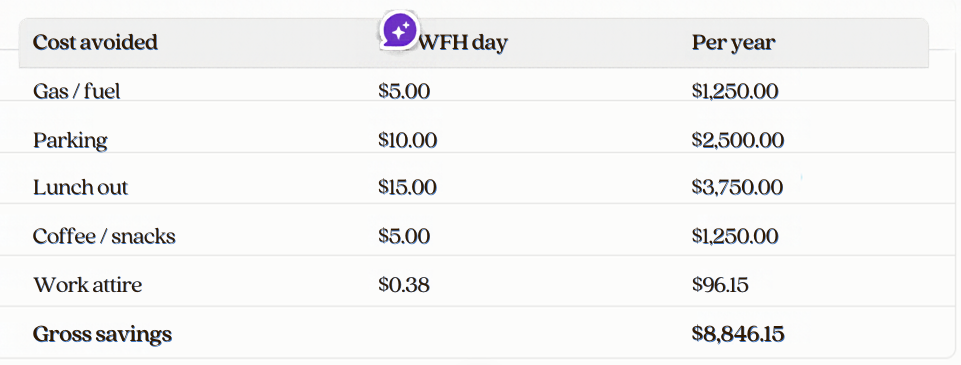
The fuel line comes from a 20-mile one-way trip: 40 miles a day ÷ 28 MPG = about 1.43 gallons, and at $3.50 a gallon that is $5.00. After $600 of extra home costs, the net saving is $8,246.15 a year. The calculator also estimates about 333 hours of commute time saved, roughly 42 full work days.
How to read your result
- Gross savings is what you no longer spend on going to the office.
- WFH extra costs is what you spend more on at home, such as electricity and internet.
- Net savings is the number that matters. It is what you actually keep.
- Time saved is not cash, but many people value it as much as the money.
Costs that often go up at home
Working from home is not free. Watch for:
- Higher electricity, heating or cooling bills
- A faster internet plan
- A desk, chair, monitor or other equipment
- Snacks and meals you now eat at home
If you live close to the office, drive a fuel-efficient car, or already pack lunch, your savings will be smaller. That is normal, and the calculator will show it.
Tips for a more accurate estimate
- Use your real fuel receipts or a month of bank statements, not guesses.
- Include tolls and public transit fares in the parking or commute figure if they apply to you.
- For a hybrid schedule, set the WFH days to match your real week.
- Update the gas price when it changes.
- Think about what you will do with the savings. Paying down debt or investing can add up. Try our Credit Card Payoff Calculator or ROI Calculator.
Frequently Asked Questions
It depends on your commute, parking and food habits. With the calculator’s example values, a full-time remote worker saves about $8,246 a year after home costs. Your number could be much lower or higher.
Usually, yes, but not always. You save on fuel, parking and daily spending, but you may pay more for utilities and equipment. Enter your own costs to see your real result.
Yes. Set your office days and WFH days per week, and the yearly totals update to match.
Think about extra electricity, internet, and any desk or equipment you bought. The calculator uses a set amount for extra home costs, so compare it with your own bills.
It depends on your country and job type. In the US, rules for employees and self-employed people differ. See IRS Publication 587 or ask a tax professional. This calculator does not include tax effects.
Before you rely on this result
Results are estimates based on the figures you enter. They exclude fees, taxes and inflation unless stated, and they assume the rate you supply holds for the whole period. For a decision that matters, confirm the numbers with the lender, provider or a qualified adviser.
Related Finance calculators
See all Finance →- Tip SplitterSplit the bill and tip evenly or by custom amounts per person.
- Simple Interest CalculatorCalculate simple interest on a principal amount.
- Credit Card Payoff CalculatorSee how long to pay off credit card debt and interest saved.
- Payment CalculatorFind monthly payment, loan amount, term, or interest rate.
- Retirement CalculatorProject 401k/IRA savings growth to retirement with year-by-year table.
- ROI CalculatorCalculate Return on Investment and annualized ROI for any investment.
More from Finance
View all posts →Longer reads from our finance collection.