Compound Interest Calculator: How to Calculate Compound Interest Easily
Learn how to calculate compound interest using the formula, understand monthly, quarterly and annual compounding, and use a compound interest calculator to estimate your returns.
If you've ever wondered why your savings account barely grows while your friend's investment doubled in a decade, the answer usually comes down to one word: compounding. A compound interest calculator takes the guesswork out of this by instantly showing how your money grows over time, but understanding the math behind it helps you make smarter financial decisions.
In this guide, you'll learn what compound interest is, the formula behind it, how to calculate it manually, and how a calculator saves you time and errors.
What Is Compound Interest?
Compound interest is interest calculated on both the original principal and the interest that has already been added to it. Unlike simple interest, which only grows on the initial amount, compound interest snowballs, your interest starts earning its own interest.
This is why Albert Einstein reportedly called compound interest "the eighth wonder of the world." Whether you're saving, investing, or paying off a loan, understanding how it works can significantly change your financial outcomes.
Simple Interest vs. Compound Interest
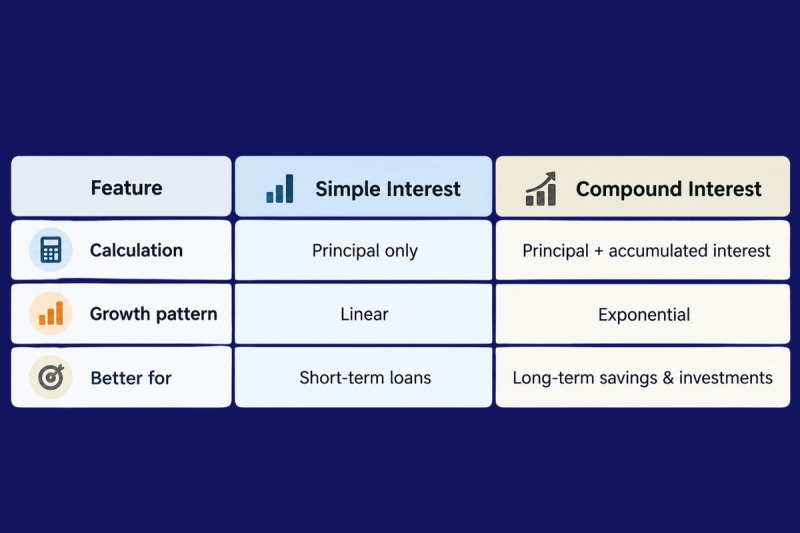
Over short periods, the difference is small. Over 10, 20, or 30 years, compound interest can result in dramatically higher returns.
The Compound Interest Formula
The standard formula for compound interest is:
A = P (1 + r/n)^(nt)
Where:
- A = the future value of the investment (principal + interest)
- P = the principal amount (initial investment)
- r = annual interest rate (in decimal form)
- n = number of times interest compounds per year
- t = number of years
To find just the interest earned, subtract the principal from the total:
Interest = A − P
How to Calculate Compound Interest Manually (Step-by-Step)
Let's walk through a real example.
Scenario: You invest ₹50,000 at an annual interest rate of 8%, compounded monthly, for 5 years.
Step 1: Identify your variables
- P = 50,000
- r = 0.08
- n = 12 (monthly compounding)
- t = 5
Step 2: Plug into the formula
A = 50,000 × (1 + 0.08/12)^(12×5)
Step 3: Solve step by step
- 0.08/12 = 0.00667
- 1 + 0.00667 = 1.00667
- 12 × 5 = 60
- 1.00667^60 ≈ 1.4898
Step 4: Multiply by principal
A = 50,000 × 1.4898 ≈ ₹74,490
Step 5: Find interest earned
Interest = 74,490 − 50,000 = ₹24,490
So your ₹50,000 grows to roughly ₹74,490 in five years, nearly ₹24,490 in interest alone, purely from compounding.
Why Use a Compound Interest Calculator Instead?
Doing this math by hand works fine for one scenario, but it becomes tedious and error-prone when you want to:
- Compare different compounding frequencies (daily, monthly, quarterly, annually)
- Test multiple interest rates side by side
- Factor in regular monthly contributions
- Plan for retirement, education, or long-term savings goals
A compound interest calculator does all of this instantly. Instead of manually solving exponents, you simply enter your principal, rate, time period, and compounding frequency and get an accurate, instant result along with a year-by-year growth breakdown.
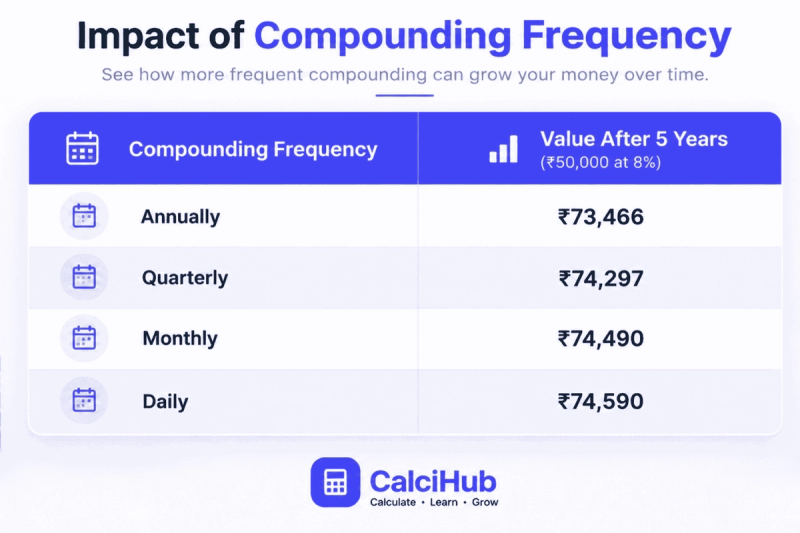
This is especially useful when comparing compounding frequency, since more frequent compounding leads to slightly higher returns:
How Compounding Frequency Affects Your Returns
Many people overlook compounding frequency, but it matters more than most assume, especially over long time horizons. Daily compounding will always outperform annual compounding at the same rate, though the difference shrinks as the rate gets lower. This is one of the biggest reasons to run your numbers through a calculator rather than estimating.
Tips to Maximize the Power of Compound Interest
- Start early. Time is the biggest multiplier in the compound interest formula. Starting 10 years earlier can outweigh contributing significantly more money later.
- Choose frequent compounding when possible. Daily or monthly compounding beats annual compounding.
- Reinvest your earnings. Withdrawing interest early breaks the compounding cycle.
- Make consistent contributions. Adding a fixed amount monthly accelerates growth far beyond a single lump sum.
- Be patient. Compound growth looks slow in the early years and accelerates dramatically later, this is often called the "hockey stick" effect.
Frequently Asked Questions
1. What is the easiest way to calculate compound interest?
The fastest and most accurate way is using an online compound interest calculator, where you simply input your principal, rate, time, and compounding frequency.
2. How often should interest compound for the best returns?
Daily or monthly compounding generally yields better returns than annual compounding, though the difference is modest at lower interest rates.
3. Does compound interest work for loans too?
Yes. While it benefits savers and investors, compound interest also increases the amount owed on loans and credit cards, which is why paying off high-interest debt quickly matters.
4. Can I calculate compound interest with monthly contributions?
Yes, though the basic formula above assumes a single lump sum. For recurring monthly deposits, a compound interest calculator with a contribution feature gives a much faster and more accurate result.
Final Thoughts
Understanding how to calculate compound interest gives you a real edge in personal finance, whether you're growing savings, planning investments, or evaluating a loan. While the formula is straightforward once you know it, a compound interest calculator removes the manual work and lets you instantly test different scenarios.
Try our free Compound Interest Calculator on CalciHub to see exactly how your money can grow over time, no manual math required.
Put this to work
All Finance calculators →Free tools that do the arithmetic in this article for you.
- EMI CalculatorCalculate Equated Monthly Installment for home, car, or personal loans with full schedule.
- SIP CalculatorSystematic Investment Plan — estimate mutual fund SIP returns with year-by-year growth.
- GST CalculatorAdd or remove GST for all Indian tax slabs (5%, 12%, 18%, 28%) with CGST/SGST split.
- YouTube Earnings CalculatorEstimate YouTube ad revenue, sponsorships, and memberships from views and CPM.