Salary Calculator: Hourly to Yearly and Monthly Pay
Want to know what your hourly pay means per year, or your yearly salary per hour? Enter your pay in this salary calculator and get your monthly, weekly and annual numbers instantly.
Pay Period Breakdown
| Period | Amount |
|---|---|
| Hourly | $36.06 |
| Daily | $288.46 |
| Weekly | $1,442.31 |
| Bi-weekly | $2,884.62 |
| Semi-monthly | $3,125.00 |
| Monthly | $6,250.00 |
| Annual | $75,000.00 |
Tax Estimation (2024)
* Federal estimate only. Does not include state/local taxes, FICA, or deductions beyond standard.
2024 Federal Tax Brackets (Single Filer)
| Bracket | Income Range | Tax Rate | Tax in Bracket |
|---|---|---|---|
| 10% | $0.00 – $11,600.00 | 10% | $1,160.00 |
| 12% | $11,601.00 – $47,150.00 | 12% | $4,265.88 |
| 22% | $47,151.00 – $100,525.00 | 22% | $2,914.78 |
| 24% | $100,526.00 – $191,950.00 | 24% | — |
| 32% | $191,951.00 – $243,725.00 | 32% | — |
| 35% | $243,726.00 – $609,350.00 | 35% | — |
| 37% | $609,351.00 – above | 37% | — |
How To Use The Salary Calculator
- Enter your pay. Type the amount you earn.
- Pick the pay period. Choose hour, day, week, biweekly, month or year.
- Add your working hours. Most full-time jobs are 40 hours a week. Change it if you work fewer or more.
- Add time off (optional). Enter your paid holidays and vacation days to get a more realistic figure.
- Read your results. Your pay is shown for every period at once, so you can compare offers easily.
How To Calculate Salary From An Hourly Wage
You don't need a calculator for the basic version. The formula is:
Yearly salary = hourly rate × hours per week × 52 weeks
Take someone earning 25 an hour on a 40-hour week:
- Weekly pay: 25 × 40 = 1,000
- Yearly pay: 1,000 × 52 = 52,000
- Monthly pay: 52,000 ÷ 12 = about 4,333
- Biweekly pay: 52,000 ÷ 26 = 2,000
- Daily pay (8-hour day): 200
The tool does this for you, but it helps to know where the numbers come from.
How To Convert Yearly Salary To Hourly Pay
Going the other way is just as easy. A full-time year has about 2,080 working hours (40 hours × 52 weeks). Divide your yearly salary by that number:
Hourly rate = yearly salary ÷ 2,080
So a 60,000 salary comes to about 28.85 an hour.
If you only know your monthly pay, multiply it by 12 first. For example, 4,000 a month is 48,000 a year, which is about 23.08 an hour.
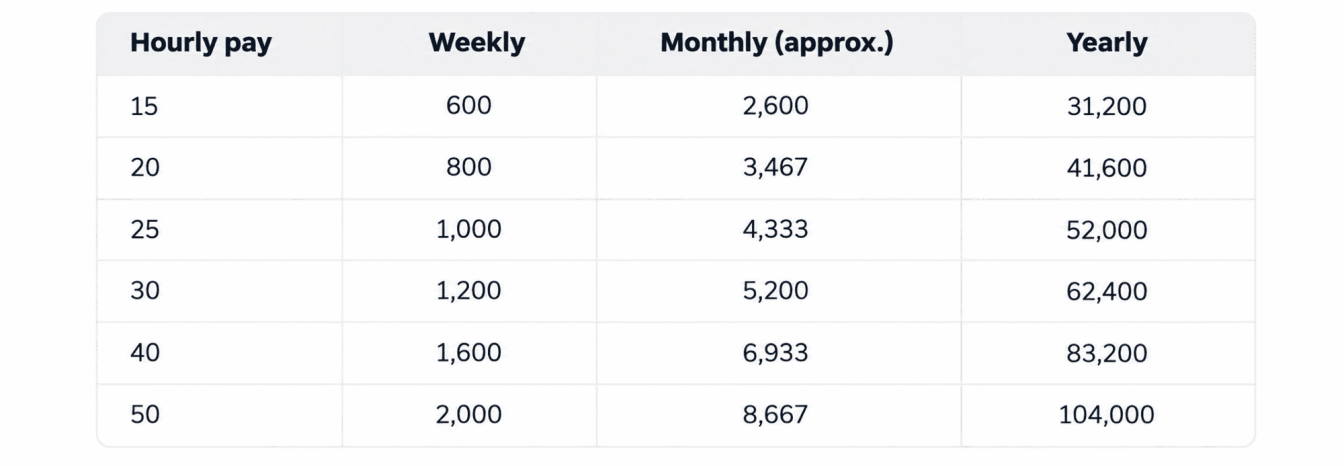
Quick reference: Hourly Pay Converted To Yearly & Monthly
These figures assume 40 hours a week, 52 weeks a year, with no unpaid time off.
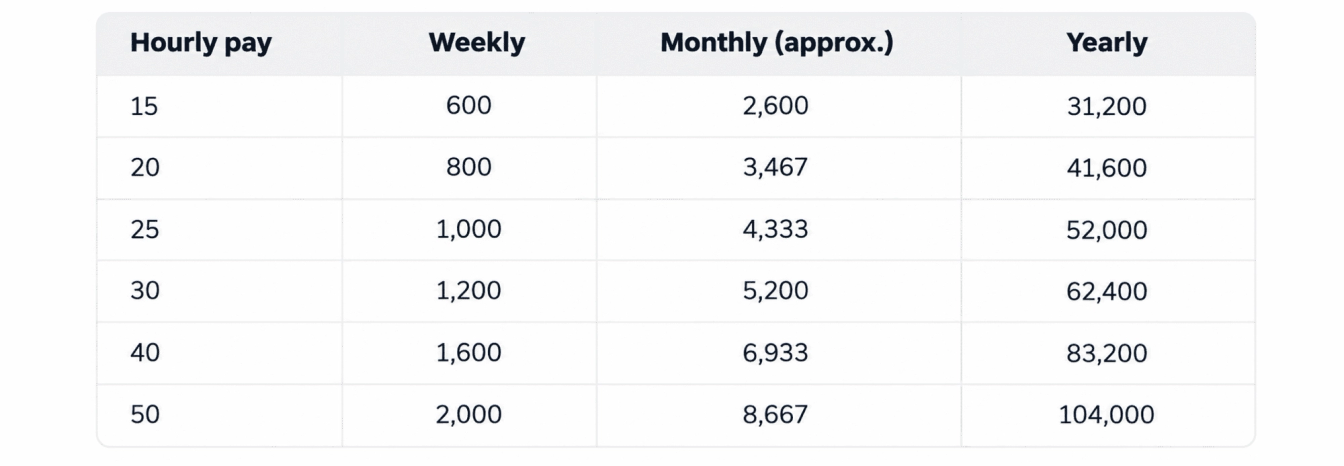
Quick Reference: Yearly Salary Converted To Hourly Pay
Does Time Off Change Your Salary?
It depends on how you're paid.
If you're on a fixed yearly salary with paid leave, nothing changes. You get the same pay whether you take a holiday or not.
If you're paid by the hour and time off is unpaid, your real yearly income is lower than the simple formula shows. Here's an example:
- A normal year has about 260 working days (5 days × 52 weeks).
- Take away 10 holidays and 15 vacation days. That leaves 235 working days.
- At 8 hours a day, that's 1,880 paid hours.
- At 25 an hour, you earn 25 × 1,880 = 47,000, not 52,000.
That's a 5,000 difference, and it's easy to miss when comparing job offers. This is why the calculator lets you enter your holidays and vacation days.
Gross Pay vs Take-Home Pay
The results on this page show your gross pay, which is what you earn before tax and other deductions.
Your take-home pay (net pay) will be lower. Income tax, social security, insurance and retirement contributions all depend on your country, your state or region, and your employer. For the exact amount, check your payslip or use a tax calculator for your location.
Weekly, Biweekly, Semi-Monthly, and Monthly Pay: What's The Difference?
These terms get mixed up a lot, especially biweekly and semi-monthly.
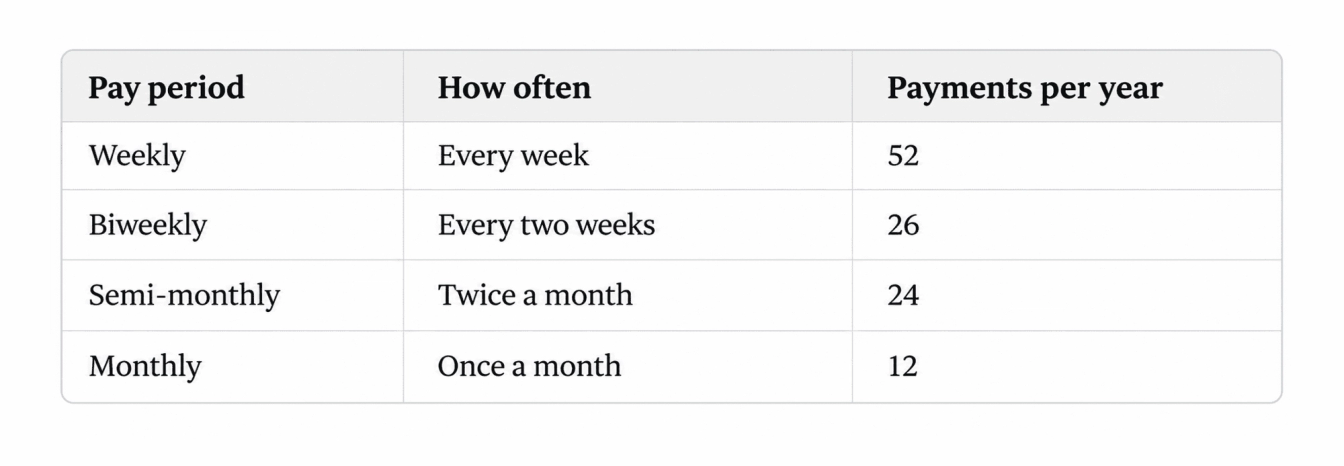
Here's the catch with biweekly pay. Since a year has 52 weeks, two months of the year will include three paychecks instead of two. Semi-monthly pay always gives you two paychecks a month, but each one is slightly larger than a biweekly paycheck.
When This Salary Calculator Is Useful
- Comparing job offers. One company lists pay per hour and another lists a yearly package. Convert both to the same period and the choice gets clearer.
- Checking a raise. See what an extra 2 an hour means over a full year.
- Setting a freelance rate. Work backward from the yearly income you want to get an hourly rate. Then add extra for unpaid leave, slow months and business costs.
- Making a budget. Turn a yearly salary into a monthly figure you can plan around.
- Checking your payslip. Confirm that the number your employer quoted matches your contract.
Frequently Asked Questions
Multiply your hourly rate by the hours you work each week, then multiply by 52. At 20 an hour for 40 hours a week, that's 20 × 40 × 52 = 41,600 a year.
A full-time schedule of 40 hours a week for 52 weeks is 2,080 hours. The number drops if you take unpaid leave or work fewer hours.
Multiply your monthly pay by 12 to get the yearly amount, then divide by 2,080. For example, 4,000 × 12 = 48,000, and 48,000 ÷ 2,080 = about 23.08 an hour.
Before tax. It shows gross pay only.
Payslips include tax, deductions, overtime, bonuses and allowances. Some employers also count working days a little differently, so small differences are normal.
Yes. Change the hours per week to match your schedule, such as 20 or 25 hours instead of 40.
A salary is a fixed amount, usually quoted per year or month, no matter how many hours you work in a given week. Wages are paid by the hour, so your income changes with the hours you work.
Before you rely on this result
Results are estimates based on the figures you enter. They exclude fees, taxes and inflation unless stated, and they assume the rate you supply holds for the whole period. For a decision that matters, confirm the numbers with the lender, provider or a qualified adviser.
Related Finance calculators
See all Finance →- Discount CalculatorFind sale price, discount percentage, or original price.
- Compound Interest CalculatorSee how your investments grow with compound interest over time.
- Income Tax CalculatorEstimate 2026 US federal income tax with a bracket-by-bracket breakdown.
- CAGR CalculatorCompound Annual Growth Rate — find CAGR, future value, present value, or time to goal.
- Auto Loan CalculatorCar loan calculator with trade-in, down payment, and tax.
- Currency ConverterConvert between 25 major currencies using live exchange rates.
More from Finance
View all posts →Longer reads from our finance collection.